Whether in a classroom or lab, teaching must be student-centered, holistic, and equitable. By fostering a supportive, engaging environment and recognizing all of students’ needs (educational, emotional, and biological), I empower students to demonstrate mastery or seek additional support as needed—an approach known to increase success and enhance well-being.
Teaching Philosophy:
Evidence-based strategies:
-
inquiry-based learning through real-world problem-solving
-
hands-on, experiential activities (in the classroom, lab, or field)
-
active learning exercises (e.g., case studies and debates)
Mentoring Philosophy:
Key practices:
-
align students’ academic progress with personal goals and well-being
-
foster independent problem-solving by providing space to explore and reflect
-
encourage outside collaboration and/or mentorship
Student-led research
My students have gone on to pursue careers in academia, state/federal agencies, and the private sector. To date, I have mentored 20 students across career stages (15 undergraduate, 2 master’s, 3 doctoral), including 12 women, 6 men, and 2 non-binary students. Together, we have produced 18 conference presentations, 1 undergraduate thesis, and 10 student co-authored peer-reviewed manuscripts. Half of my undergraduate mentees have pursued advanced degrees (7 M.S., 3 Ph.D.), with many crediting our mentoring relationship as pivotal to their development as scientists.
Previous courses
Environmental Science | University of Florida
Senior-level course | 2022 – 2024
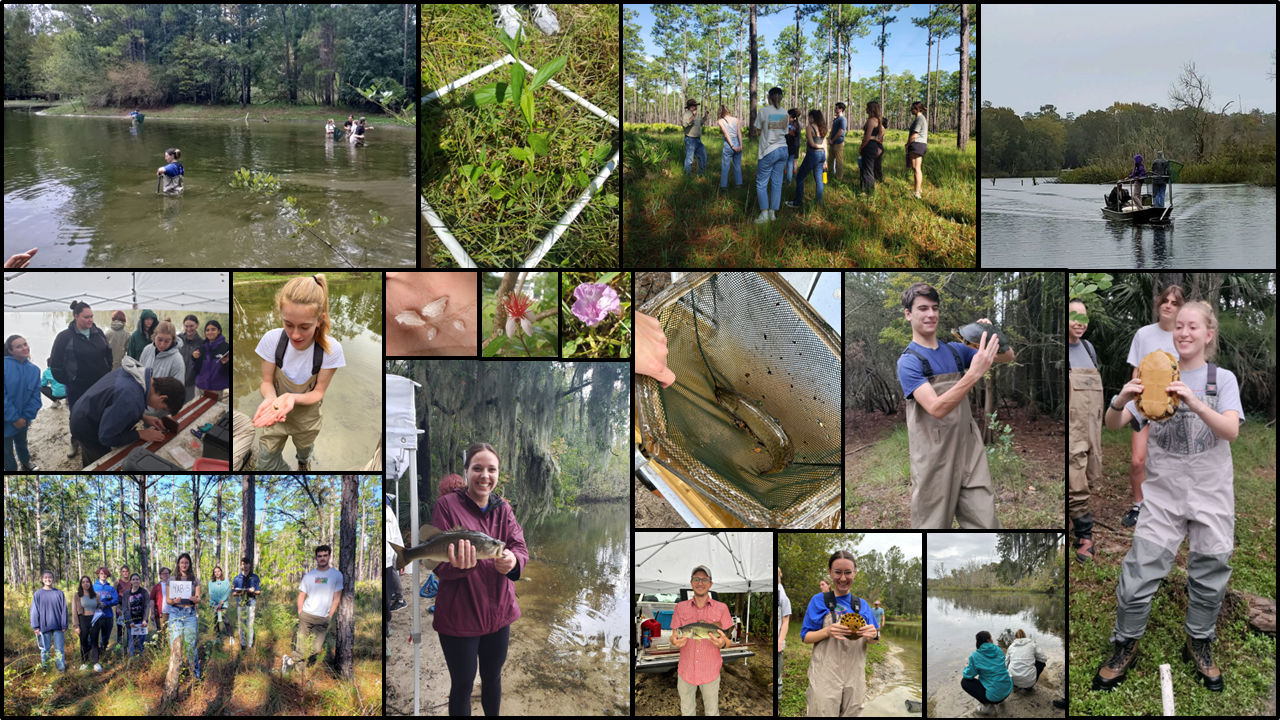
A course covering population ecology, habitat management, and conservation strategies for wildlife species. Students learn to apply quantitative methods to real conservation problems.
- Topics: Land management, Climate science, social-ecological systems, environmental justice, sustainability, invasive species
- Methods: R programming, GIS analysis, field techniques, technical writing, science communication
- Enrollment: 12 students